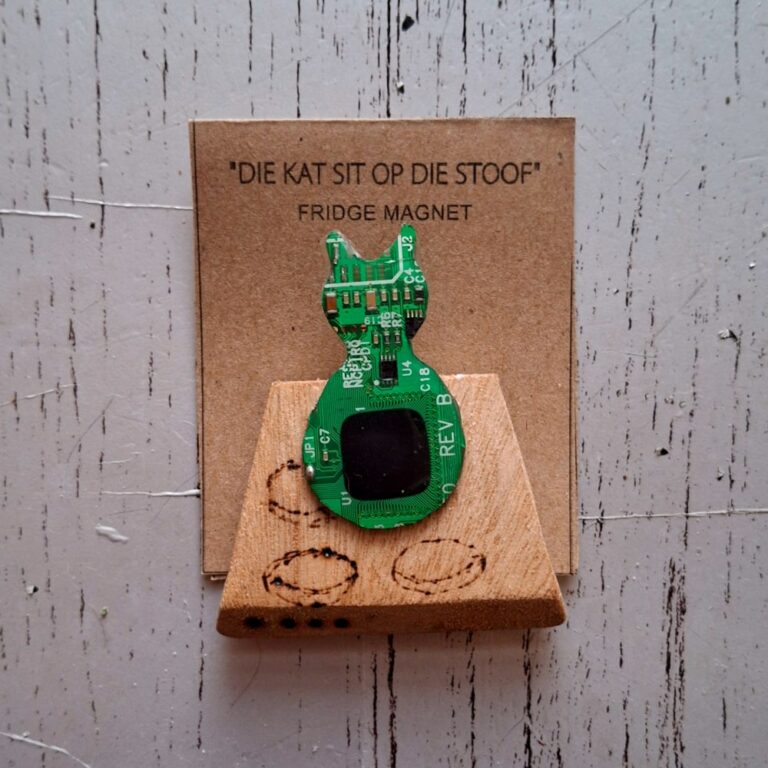
Story And Origin Of The Afrikaans Idiom DIE KAT SIT OP DIE STOOF
Are you familiar with the Afrikaans idiom “Die Kat sit op die stoof,” which translates to “The cat sits on the stove”?
Don’t beat yourself up if you haven’t. Even me, a self-confessed cat extremist with Afrikaans as my mother tongue had never encountered the saying until I met Vincent at Kuier @ the Castle, a lively Cape Town craft market happening on the last Saturday of each month during spring and summer.
Vincent is an eco-conscious South African designer from De Doorns, a small town outside Worcester. The retired artist stays mentally engaged and hands-on by transforming electronic waste into innovative, functional artworks that enhance daily life. How rad is that?!
Getting back to the topic on hand, or rather hot stove; what is the story and origin of the idiom that makes mention of a cat and what exactly does it mean?
Some word experts say this idiom is used to describe a situation where no food is available or the kitchen is “closed.”
Many moons ago, coal stoves were commonly used for cooking, providing consistent heat unless the household had no food to prepare, in which case the stove remained cool.
Others interpret it as a way of saying someone is in a difficult or awkward situation, like being stuck or having run out of options.
As unfamiliar some of us might be with the Idiom, a singer that calls himself Appel on Youtube wrote and recorded Kat is op die Stoof.
There’s a quote by Mark Twain, another self-confessed as a cat extremist, that reads:
“If a cat sits on a hot stove, that cat won’t sit on a hot stove again. That cat won’t sit on a cold stove either. That cat just don’t like stoves.” – Mark Twain.
Twain’s quote underscores how negative experiences can lead to overgeneralization, causing individuals—like a cat burned by a hot stove—to develop excessive caution that extends beyond the original danger, such as avoiding cold, safe stoves. This illustrates the broader risk of learning misguided lessons from adverse events, which can result in unnecessary avoidance of harmless or beneficial situations. In a nutshell, highlighting the importance of nuanced learning and discernment in response to setbacks.